Practical use cases

Practical read aloud examples that fit your day

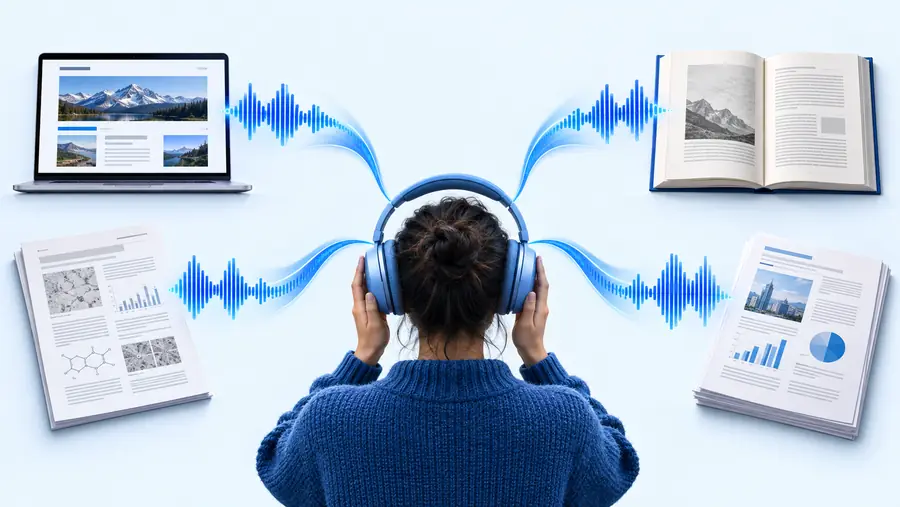
These read aloud examples show how a voice reader can support focused study, easier review, accessible reading, and hands-free listening without changing the material itself.

Written content is not always easiest to use with your eyes on the page. A repeatable listening workflow helps when attention, accessibility, time, or physical comfort gets in the way.

Three concrete workflows

Each workflow starts with text you already need to use and ends with a listening action you can repeat. Keep the first pass simple, then adjust your pace or stopping points to match the task.

  1. 1

    Prepare the text

    Choose a short article, study passage, document, or story. Remove distracting navigation, duplicate headings, and unrelated notes so the spoken version follows a clean path.

  2. 2

    Listen with a purpose

    Start with a question: What is the main idea, which facts matter, or where does the argument change? Listening with a purpose makes the session more active than background audio.

  3. 3

    Review the useful parts

    Pause after a section, repeat a difficult passage, or write a brief summary in your own words. Save only the notes or timestamps that help with the next step.

Example output

The same source can produce different listening formats depending on the job. This comparison keeps the content stable while changing how the listener approaches it.

1

Starting material

Unstructured listening

A full page with headings, links, and side notes

Purposeful listening workflow

The relevant passage with distractions removed

2

Primary goal

Unstructured listening

Get through the text

Purposeful listening workflow

Answer a question or understand a defined section

3

Pace choice

Unstructured listening

One fixed pace for every paragraph

Purposeful listening workflow

A comfortable pace with slower sections when needed

4

Attention cue

Unstructured listening

Audio plays without a stated purpose

Purposeful listening workflow

A prompt identifies what to notice

5

Pause behavior

Unstructured listening

Pauses happen only after losing focus

Purposeful listening workflow

Planned pauses separate ideas and support recall

6

Review result

Unstructured listening

A vague sense of having listened

Purposeful listening workflow

A short summary, marked passage, or next action

7

Best fit

Unstructured listening

Casual exposure when detail is not important

Purposeful listening workflow

Study, document review, accessibility, or careful reading

Compliance notes

A voice reader changes the delivery of text, not the responsibilities attached to the source. Use material in ways that respect permission, privacy, and the needs of the people listening.

The focused student

A learner has a long assigned article and wants to hear the argument after an initial visual read.

The student listens for the thesis, pauses at section changes, and creates a short review note instead of replaying the entire article.

read aloud examples for students

The busy adult

A professional has a saved report or article but limited uninterrupted time to read it on screen.

The listener uses a purposeful pass during a suitable break, then returns to the source for details that require visual checking.

read aloud for adults

The accessibility-minded reader

A reader finds sustained visual reading tiring or wants another way to access written information.

Spoken delivery can reduce the need to stay visually locked to the page while preserving the option to inspect the original text.

10 benefits of reading aloud

The story listener

Someone wants to experience a short story or essay while doing a low-attention household task.

The listener chooses material that does not require constant visual reference and stops when concentration or comprehension drops.

read aloud for adults

Compliance notes

A clear source and a focused listening pass are easier to review than a page copied wholesale into an improvised audio session.

  • Source as found
  • Prepared listening view

Prepare only the material you need, and keep the original source available for verification.

A dense article page with several visible sections and distractions
A cleaner reading view prepared for focused listening

Compliance notes

Turn a reading task into a listening routine

Bring a passage, article, document, or story into a workflow that has a purpose from the start. A voice reader can help you change the mode of access while keeping your review grounded in the original text.

Try a voice reader
  • Choose material you are allowed to process
  • Listen for one clear purpose at a time
  • Return to the source before making important decisions

Scenario FAQ

These answers cover common questions people ask when looking for practical ways to use spoken text.

Common examples include listening to a study passage to identify its main idea, hearing an article during a review session, and using spoken text when sustained visual reading is tiring. Stories, reports, instructions, and personal notes can all fit when the listener has a clear purpose.

Start with a question or outcome instead of pressing play without a plan. Use a manageable section, pause at natural breaks, and write a short summary or next action after listening.

Listening and visual reading provide overlapping but different experiences. Spoken delivery can support access, pacing, and attention, while the original page remains important when you need to inspect layout, spelling, citations, diagrams, or exact wording.

Check that you have permission to process the document and avoid sharing confidential or personally identifying material without authorization. Keep the source available so you can verify important details, quotations, and formatting.

Try text to speech
Try text to speech