Student revising notes
A student needs to locate a definition in several pages of notes.
Start silently to find the relevant section, then say the definition in your own words to check understanding.
read aloud vs booksReading choices
Which is better, reading aloud or silently? Neither wins every time. Readaloud helps you decide whether you need a quiet first pass, a chance to hear difficult wording, or practice saying the words yourself.
For a long article in a quiet library, pick silent reading: you can scan, pause, and revisit a paragraph without disturbing anyone. For a presentation draft, pick reading aloud: your ear may catch sentences that look fine on the page but feel awkward to say. For a bedtime story with a child, pick reading aloud so you can share the pace, expression, and questions.
The right method depends on the setting and the reader. Neither approach guarantees comprehension on its own.
It is possible to pronounce every word while missing the argument, especially in dense or unfamiliar material.
WorkaroundStop after each section and explain its main point in your own words.
A sentence may look clear until you try to speak it; silent reading alone cannot test breath, rhythm, or pronunciation.
WorkaroundRead the final draft aloud once, then revise phrases that make you stumble.
Speaking can disturb others, while silent reading may be difficult when your attention is divided or your eyes need a break.
WorkaroundChange location or reading method when practical, and follow any rules about using audio in shared spaces.
Decide whether you need to survey information, study it closely, practice speaking, or share it with someone. A quick survey usually favors silent reading; speaking practice calls for reading aloud.
Consider who can hear you, how much time you have, and whether you need to jump between sections. If speaking would be disruptive, save an aloud pass for later.
Read a paragraph using your first choice, then state what it says without looking. If you cannot, slow down, reread it, or try the other method rather than forcing the whole document through one approach.
These are practical tendencies, not scores or promises. Your familiarity with the subject and the difficulty of the text may matter more than the method.
Reading aloud
Silent reading
Reading aloud
Speaking each sentence slows a quick search.
Silent reading
Eyes can move between headings and keywords without voicing every word.
Reading aloud
Reveals awkward phrasing and places where you run out of breath.
Silent reading
Helps with edits, but does not test how the speech sounds.
Reading aloud
May distract people nearby.
Silent reading
Usually suits a library, classroom, or shared office better.
Reading aloud
Gives listeners a common pace and room to ask questions.
Silent reading
Works for each reader independently, but not as a shared spoken activity.
Reading aloud
Can help you notice difficult wording; you still need to explain what it means.
Silent reading
Makes it easy to stop and reread; you still need to check what you retained.
Reading aloud
Exposes repetition, long sentences, and unnatural transitions.
Silent reading
Makes it easier to inspect structure and compare passages.
Reading aloud
Nearby people may overhear sensitive text.
Silent reading
Keeps the words unspoken, though you must still protect the document.
A page can feel familiar without being understood, whether its words stay in your head or come out of your mouth.
These illustrations show two ways to engage with text, not a measured before-and-after result. With either approach, pause to recall the main idea, identify what is unclear, and return to the source. Hearing a passage is not the same as explaining it; recognizing it on a page is not the same as remembering it.

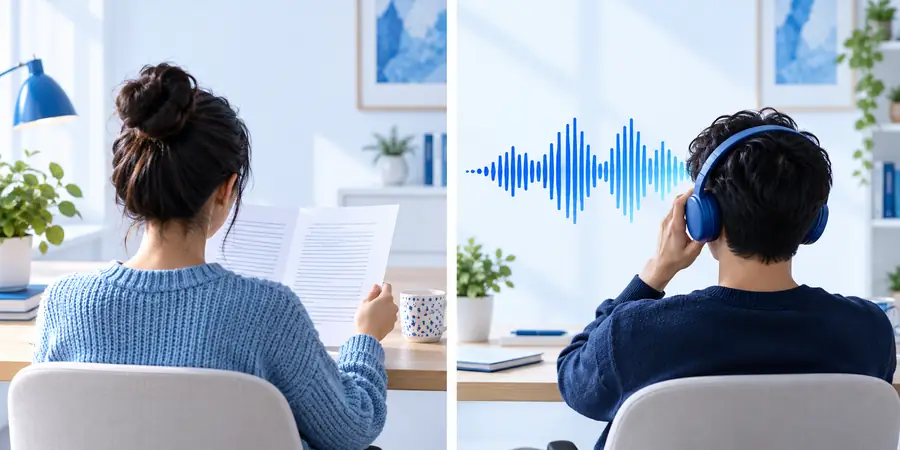
A change in purpose can change the best pick, even for the same reader and the same text.
A student needs to locate a definition in several pages of notes.
Start silently to find the relevant section, then say the definition in your own words to check understanding.
read aloud vs booksA writer has finished a first pass and wants to find sentences that sound unnatural.
Read the draft aloud after a silent structural edit; mark phrases that interrupt the flow.
how to do a read aloudA commuter wants to revisit text but cannot comfortably study the page while traveling.
Consider listening when it is safe and appropriate, then inspect important details on the page later.
read aloud alternative freeA parent and child want to explore a story together rather than finish it quickly.
Read aloud, pause for questions, and let the conversation set the pace.
how to do a read aloudReadaloud's practical recommendation is to begin with your goal, not a rule that one method is always superior. Silent reading is often the simpler choice for private scanning and close visual inspection. Read aloud when you want to test spoken wording or share a passage; consider voice tools when listening would better fit your circumstances. Keep checking what you understand either way.
Explore voice toolsThe better choice depends on what you are trying to do. Silent reading generally suits scanning and quiet settings; reading aloud suits speaking practice, shared stories, and checking how written sentences sound. For difficult material, try a short passage both ways and check whether you can explain it.
It can make confusing wording more noticeable and encourage a slower pace, but speaking the words does not prove you understood them. Pause and summarize the passage without looking; if you cannot, reread it or ask what a difficult term means.
It is often the more practical choice when you need to scan headings, locate a detail, or move between passages. Speed alone is not the goal if you miss the point, so slow down for sections that require careful thought.
Use both methods for different checks. Review it silently for structure and accuracy, then read it aloud to find awkward transitions, difficult words, and sentences that are hard to deliver in one breath.
Listening lets you hear the text without speaking, which may be useful when you cannot comfortably look at the page. It does not replace practicing your own pronunciation or delivery if those are your goals; for that, you need to say the words yourself.