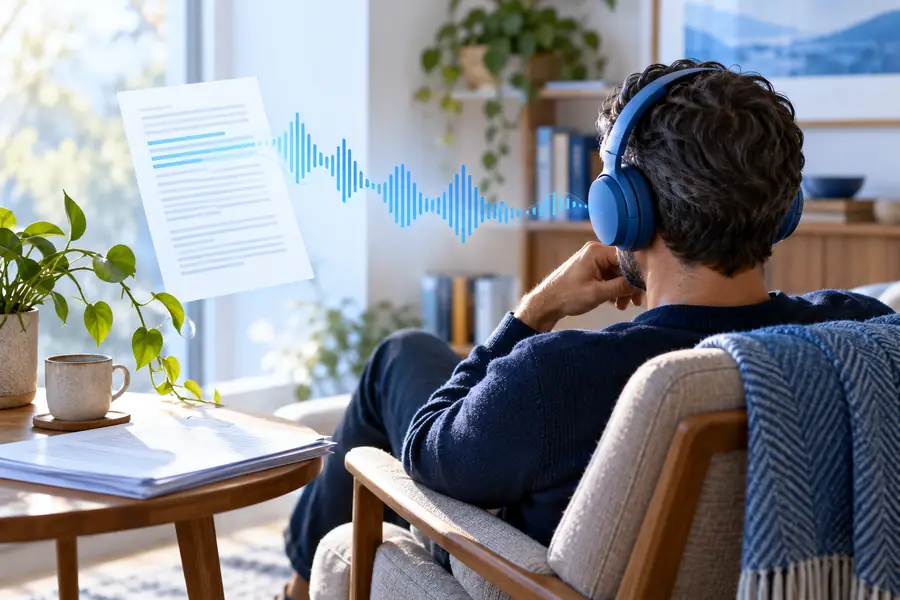
Read aloud for adults can make dense articles, study notes, and long chapters easier to follow when your eyes are tired or your attention keeps slipping. Turn selected text into a listening session with a clear purpose.
Adults often need reading support for a specific moment, not a complete change to the way they read. These workflows keep the task practical and purposeful.
The tired professional
You have a report or policy document to review after a long day, but rereading the same paragraph is slowing you down.
Listen to a section while tracking the text, then return to the page for decisions and notes.
Start with one article section, chapter extract, email, or study note. A defined stopping point makes the session easier to manage.
2
Set the listening purpose
Decide whether you are previewing, proofreading, studying pronunciation, or resting your eyes. The purpose determines how closely you should follow the words.
3
Listen, pause, and return
Let the passage play, pause when meaning becomes unclear, and return to the source text for names, figures, citations, or decisions.
Example output
From visual overload to a usable listening draft
Before: crowded source text
After: listening-ready passage
The goal is not to replace reading. It is to create a second route through the same material, with sensible pauses and a clear reason for listening.
At a glance
A routine that stays manageable
1Professional, study, and restorative listening patterns covered on this page
3workflows
2Adult scenarios where spoken text can reduce friction
4contexts
3Site locales available across the Readaloud experience
6locales
Know the limits
What this route cannot do for you
It cannot verify meaning
A voice can present the words clearly, but it cannot decide whether an argument is accurate, a statistic is current, or a source is trustworthy.
WorkaroundPause at claims, names, and figures, then check the original source yourself.
It cannot replace every close read
Contracts, prescriptions, exam instructions, citations, and safety guidance may require visual inspection of layout and exact wording.
WorkaroundUse audio as a first pass, then inspect the source line by line.
It cannot fix unclear writing
If the original passage is repetitive, poorly structured, or full of unexplained terms, listening may reveal the problem without solving it.
WorkaroundRewrite or summarize the passage before listening again.
It cannot guarantee distraction-free attention
Notifications, multitasking, and fatigue can still interrupt an adult listening session.
WorkaroundUse a short passage, one task, and a visible stopping point.
Practical comparison
Listening support beside silent reading
Read aloud workflow
Silent reading alone
1
Best starting point
Read aloud workflow
A defined passage with a specific listening purpose
Silent reading alone
Any passage when visual reading is comfortable
2
Attention channel
Read aloud workflow
Combines spoken language with optional visual tracking
Silent reading alone
Relies primarily on visual attention
3
Proofreading value
Read aloud workflow
Helps reveal awkward phrasing and repeated words
Silent reading alone
Makes visual formatting and punctuation easier to inspect
4
Complex references
Read aloud workflow
May require pausing and checking the source
Silent reading alone
Keeps footnotes, tables, and page layout immediately visible
5
Eye strain support
Read aloud workflow
Can reduce the need to look continuously at the screen
Silent reading alone
Requires sustained visual focus
6
Deep analysis
Read aloud workflow
Works well as a preview or second pass
Silent reading alone
Often gives finer control over annotation and comparison
7
Most useful result
Read aloud workflow
A more accessible route through selected material
Silent reading alone
Direct control over visual structure and detail
Give your next adult reading task a second route
Choose one passage that has been difficult to finish, define what you want from the session, and send it through the listening workflow. Read aloud support works best when it complements judgment, notes, and close reading rather than pretending to replace them.
Questions about stories read aloud online for adults
Adults can look for public-domain stories, library resources, publisher samples, and tools that turn text into spoken audio. Availability, permissions, and access conditions vary, so check the source before saving, sharing, or using a recording.
Yes. Spoken stories can support relaxation, language practice, accessibility, commuting, and attention when visual reading is tiring. Adults can choose literary fiction, essays, memoir, short stories, or study material that matches their goal.
Yes, selected articles and study notes can work well when the text is clear and the passage has a defined purpose. Keep the original source available so you can inspect headings, citations, tables, and details that audio alone may not show.
Not always. Listening can make phrasing, pacing, and emotional tone more noticeable, while silent reading often gives finer control over speed, annotation, and visual structure. Many adults benefit from using both modes for different parts of the same text.